Doodle 6 min read
difference between doodling and scribbling - a guide to hand-drawn marks
The difference between doodling and scribbling lies in what leads the line. Doodles build towards forms, motifs and small visual discoveries; scribbles foreground movement, pressure and texture. Both bring a distinctly human energy to hand-drawn design.
The difference between doodling and scribbling is simple: doodling usually lets a line develop into a recognisable form, pattern or visual idea, while scribbling prioritises the physical energy of the mark itself. One gives the eye a subject to notice; the other makes movement, pressure and texture the subject. In expressive hand-drawn work, they are often strongest when used together.
difference between doodling and scribbling - what the line is trying to do
Both doodling and scribbling can start in the same way: an unplanned line, a spare corner of paper, a hand with a little time to fill. The difference becomes apparent as the drawing grows.
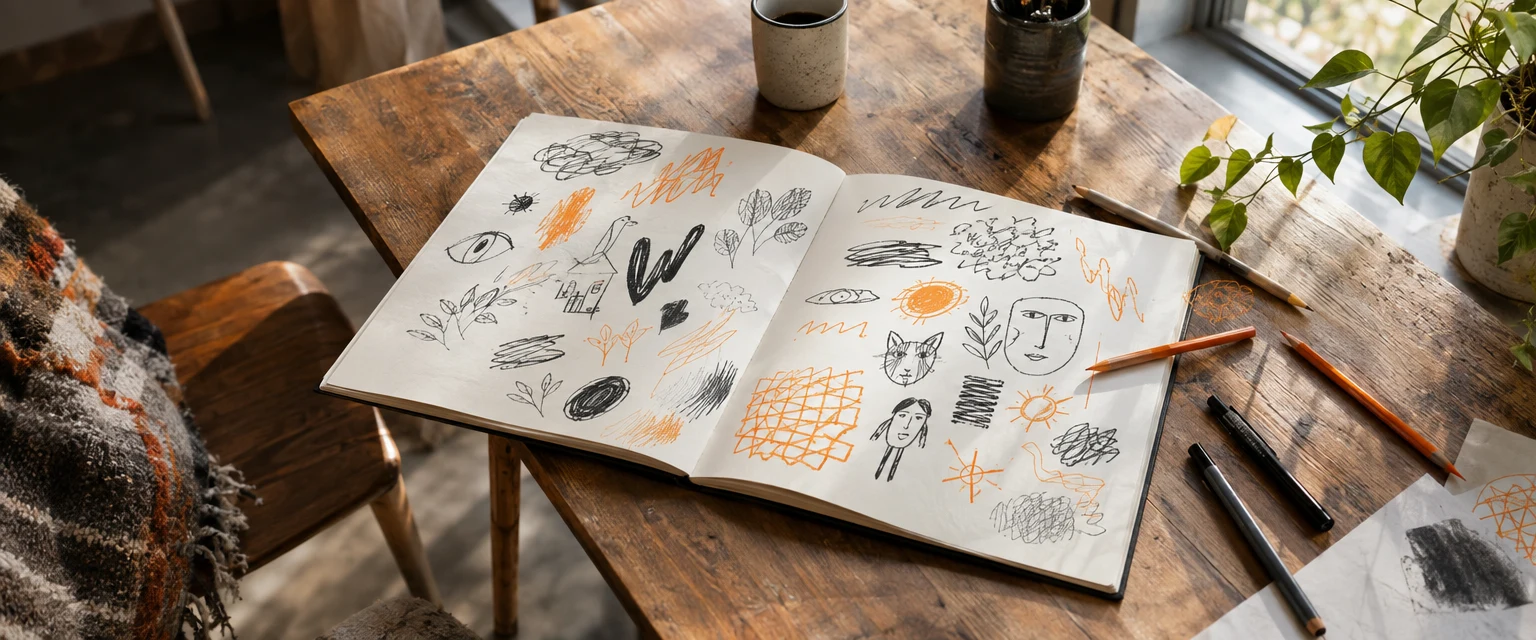
A doodle begins to organise itself. A curve turns into a face, a cluster of circles becomes a flower, or a loose outline develops into a strange little object. It need not be realistic or carefully finished, but it usually creates something the viewer can identify, trace or return to.
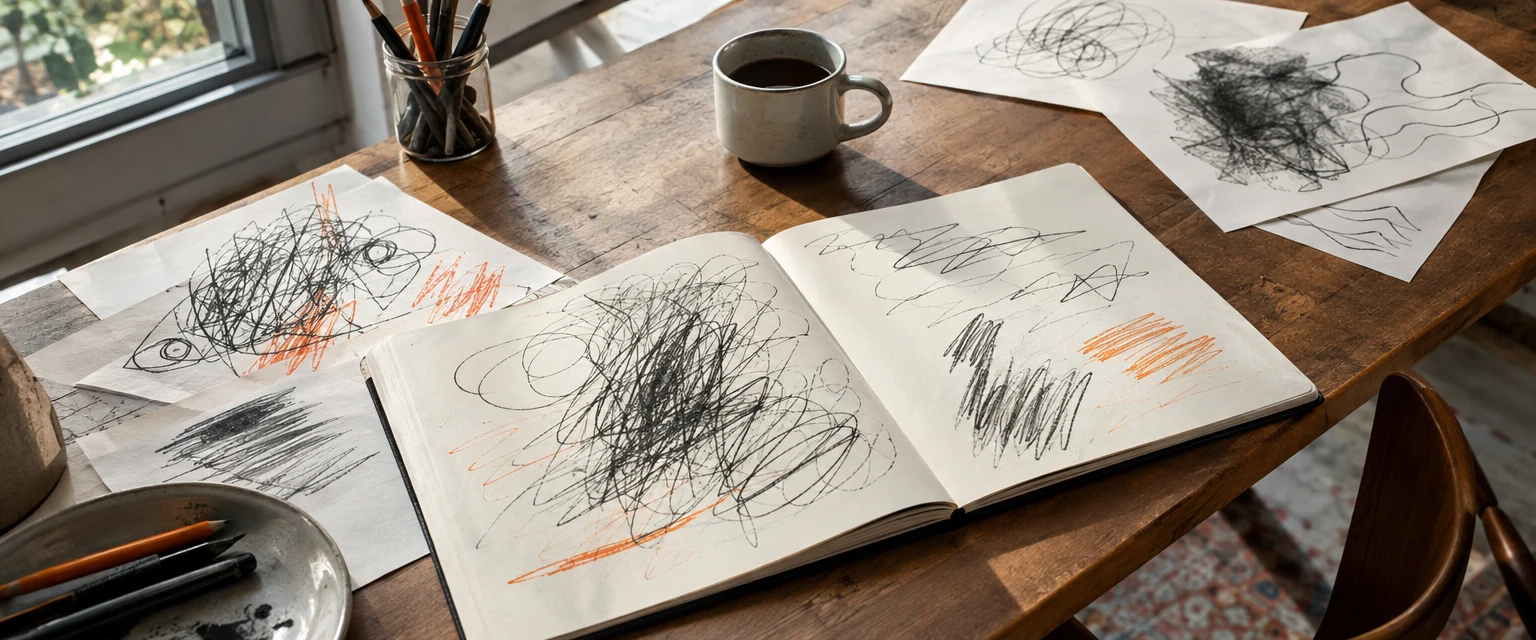
A scribble does not need to become anything at all. It may be a knot of looping pen lines, a patch of rapid pencil strokes or a repeated motion worked over the same area. Its interest lies in how it was made: the speed of the hand, the changing pressure, the crossings and interruptions.
These are descriptions, not rules. A doodle can break apart into wild marks. A scribble can unexpectedly suggest an eye, a landscape or a character. The useful question is not which label is correct, but whether the line is building a form, carrying a gesture, or doing both at once.
Doodling turns loose marks into visual discoveries
Doodling has a knack for making a small idea feel worth following. A line wanders, then acquires an edge, a feature or a repeated detail. Before long, there is a motif with its own logic: an offbeat face, a tiny scene, uneven lettering or a pattern that has grown one shape at a time.
That sense of development is part of the appeal. Doodles invite a second look because their details often reveal themselves gradually. The odd proportion, unexpected expression or slightly excessive flourish is not necessarily a mistake to remove. It can be the detail that gives a drawing its point of view.
Neatness is not the same as character. Wobbly contours, irregular spacing and changes of scale can show the route a hand took across the page. Rather than feeling anonymous or over-controlled, the result feels specific: a drawing with evidence of its own making.
In design, recognisable doodled motifs offer an immediate way in. A symbol, character or peculiar everyday object can be playful without requiring a long explanation. For current hand-drawn pieces made for everyday wear, browse new arrivals.
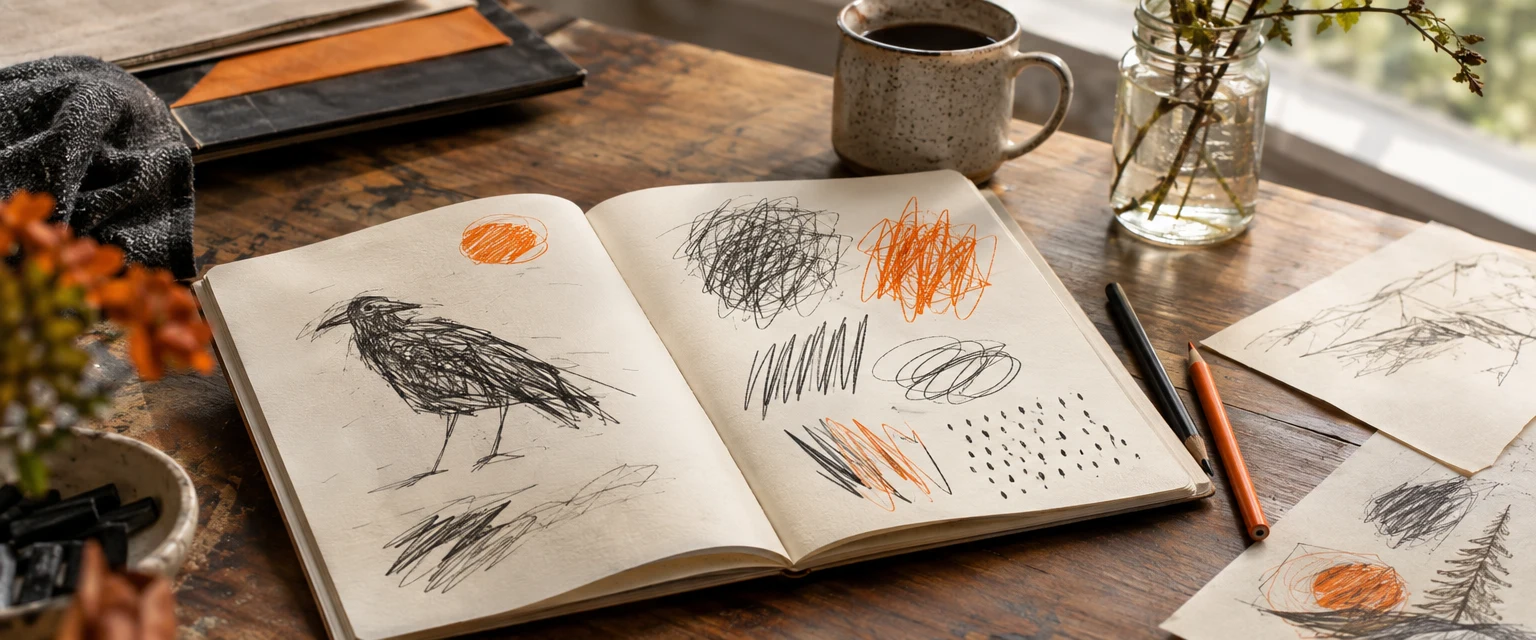
Scribbling makes movement and texture visible
Scribbling puts the mark before the outline. A pen might drag heavily, skip lightly, circle back on itself or change direction mid-thought. Even when it is deliberately arranged, a scribble can preserve the charge of an immediate impulse.
That makes it useful for creating atmosphere. Dense, overlapping marks can feel busy, loud or restless. A scattering of open loops can feel buoyant and light. Scratchy strokes can put tension behind a clearer image, making it seem to hum rather than sit still.
Scribbles also communicate without being literal. They can suggest noise, shadow, friction, uncertainty or a burst of feeling without settling into an image that needs to be named. The response is often physical before it is descriptive: the eye follows the pace of the mark.
Drawing has long been valued as a way to think, observe and test possibilities, rather than merely a route to a polished final picture. The Tate’s art collection and learning resources offer useful context for looking at line, gesture and process with fresh attention.
Why the two approaches belong in the same design
Doodles provide anchors. They give a composition forms to recognise and places for the eye to rest. Scribbles bring motion around those forms, interrupting tidiness and shifting the mood.
Picture a simple flower caught in a thicket of pencil loops, or a small character set against broken, urgent marks. The doodled element gives the viewer an entry point; the scribbled element supplies tension, softness, noise or mischief. Neither has to overwhelm the other.
The relationship can work the other way round, too. A field of abstract marks becomes easier to enter when it contains one familiar detail: a face, a symbol, a fragment of lettering. A small doodle can give structure to a restless surface while allowing the surrounding lines to remain free.
This is where hand-drawn design becomes more than a choice between polished and rough. It is a balance of order and disruption. Clear space can sit beside crowded texture; a confident outline can sit beside a line that changes its mind. The marks need not behave alike to feel as though they belong together.
Keeping the hand-drawn quality in a finished design
A drawing can be prepared for a finished design without being stripped of its original energy. Adjusting scale, contrast or placement can help it read clearly, but those choices work best when they protect the qualities that made the sketch interesting in the first place.
Uneven line weight, tiny overlaps, imperfect symmetry and irregular gaps are not always problems awaiting correction. In a hand-drawn image, they may be essential evidence of touch and timing. Remove every variation and the artwork can become technically clean but visually forgettable.
The aim is clarity, not sterility. A doodled character should still look oddly particular. A scribbled texture should still retain its direction and momentum. When refinement supports rather than replaces the original mark-making, the design can feel considered without becoming rigid.
That distinction matters especially on clothing. Artwork has to register from a distance, yet its smaller quirks can reward a closer look. A seemingly incidental line may be exactly what makes a piece feel human rather than generic.
How to choose artwork that suits your style
If you like imagery with a clear subject, start with doodle-led work. Look for characters, objects, symbols, small scenes or patterns that offer a detail to spot. These designs can feel conversational and playful while remaining easy to wear.
If you respond more to mood than to subject matter, scribble-led artwork may be a better fit. Layered, looping or scratchy marks can bring an immediate graphic edge to an outfit without needing to spell out a message.
You do not have to pick a side. Much of the most compelling hand-drawn work lives in the overlap: a defined image with an unruly edge, abstract linework with a hidden subject, or a simple motif made livelier by texture. Explore the adult collections to find the kind of linework that feels most like you.
The best hand-drawn lines leave room for surprise
Doodling and scribbling share a valuable freedom. Both allow a line to wander, repeat, tangle and alter course. That is not a lack of design; it is often the beginning of it.
A doodle may become more expressive when it keeps a little awkwardness. A scribble may become more compelling when a shape starts to emerge from the apparent chaos. Their overlap is not a boundary to police, but a generous space for visual experimentation.
For Doodles & Scribble, the terms describe two kinds of energy rather than two opposing camps. Whether a design is recognisable, abstract or somewhere between, the point is the same: hand-drawn artwork with movement, balance and a line that still feels alive.
Find your favourite
The pieces in this story, together in one place.
Explore the collection